
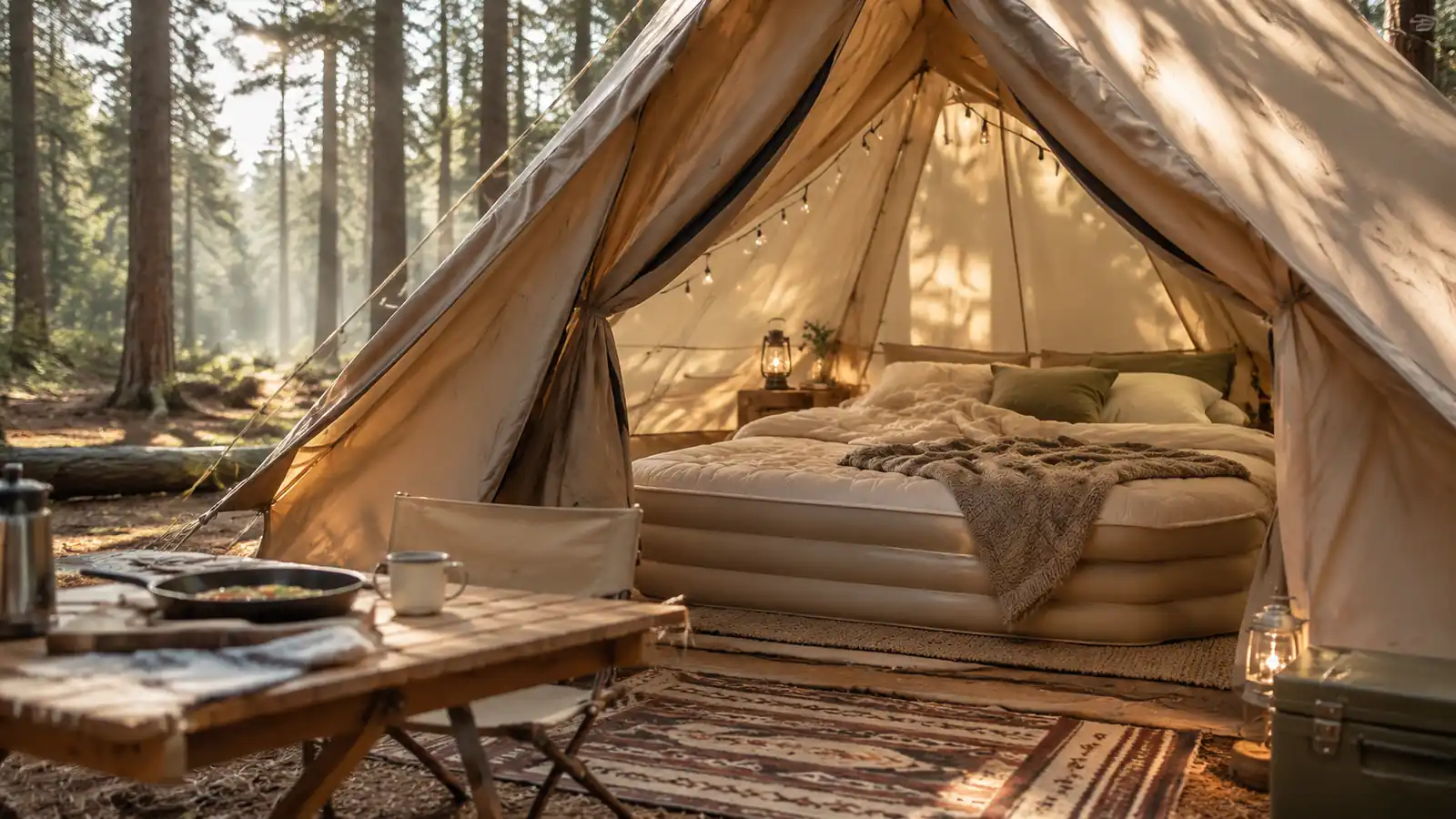
Ask me which bed you should sleep on while camping and I will answer with a question of my own: are you packing out of a car, or out of a backpack? I have spent the last two summers alternating nights, a self-inflating pad one weekend and a queen-size Intex Comfort Plush air mattress the next. Same tent, same campgrounds, same 56-year-old back. For car campers, the Intex wins. It is not close. It is the closest thing to sleeping at home that I have found under canvas, and I have been chasing that feeling since the first time I woke up stiff as a board on the ground.
The pad crowd will tell you the mattress is heavy and the pump is a fuss. Fair enough. A queen air bed needs trunk space, and this one wants a wall outlet or a 12-volt car adapter to fill. But every one of those drawbacks stops mattering right around 2 a.m., when you roll over and actually have somewhere to roll to. That is the whole trade in one sentence. Everything after this is detail.
Here is the math that settled it for me. Two hours a night of lying awake with a numb hip, times three nights a weekend, is six hours of bad sleep that follows me into Monday. The first weekend on the air mattress I woke up once around 3 a.m. to roll over, and I did not lose the other six hours. One night sold me. I have not spent a night on the ground since.
So let me be plain about who I am talking to. I stopped backpacking around the time my knees started keeping score. I camp out of a midsize SUV with a six-person dome tent in the back, a 10-inch cast iron skillet in the tub, and two folding chairs strapped to the tailgate. If that sounds like your weekend, this comparison is written for you. If you live out of a 45-liter pack, trust the sections where I tell you the pad wins, and take those seriously.
Intex Air Mattress vs Self-Inflating Sleeping Pad, Side by Side
| Intex 22-inch Queen | Self-Inflating Pad | |
|---|---|---|
| Price for comparable quality | Full queen for less than most quality pads at today's price | A good one costs more, for one sleeper only |
| Sleeping for two | True queen width, room to roll without an elbow war | Single width, strapping two pads together is fiddly |
| Getting in and out | 22 inches high, sit on the edge like a real bed | About 3 inches off the ground, a roll and a push |
| Cold-weather insulation | None built in, ground cold bleeds through on cold nights | Foam core insulates and holds warmth in frost |
| Pack size and weight | Folds to a heavy duffel that wants trunk space | Rolls about the size of a rolled sleeping bag |
| Inflation and power | Built-in pump with firm and soft buttons, needs power | Unroll and open the valve, no power needed |
| Firmness control | Add or release air every night to dial it in | Fixed by the foam, what you get is what you get |
| Long-term leak risk | Any air bed can slow-leak in season three or four | No air to lose, foam holds its shape |
| Best for | Car campers, couples, anyone with a trunk | Backpackers, bike campers, solo tents |
Six hours three inches off the cold ground makes a liar out of every weight argument.
Where Intex Wins
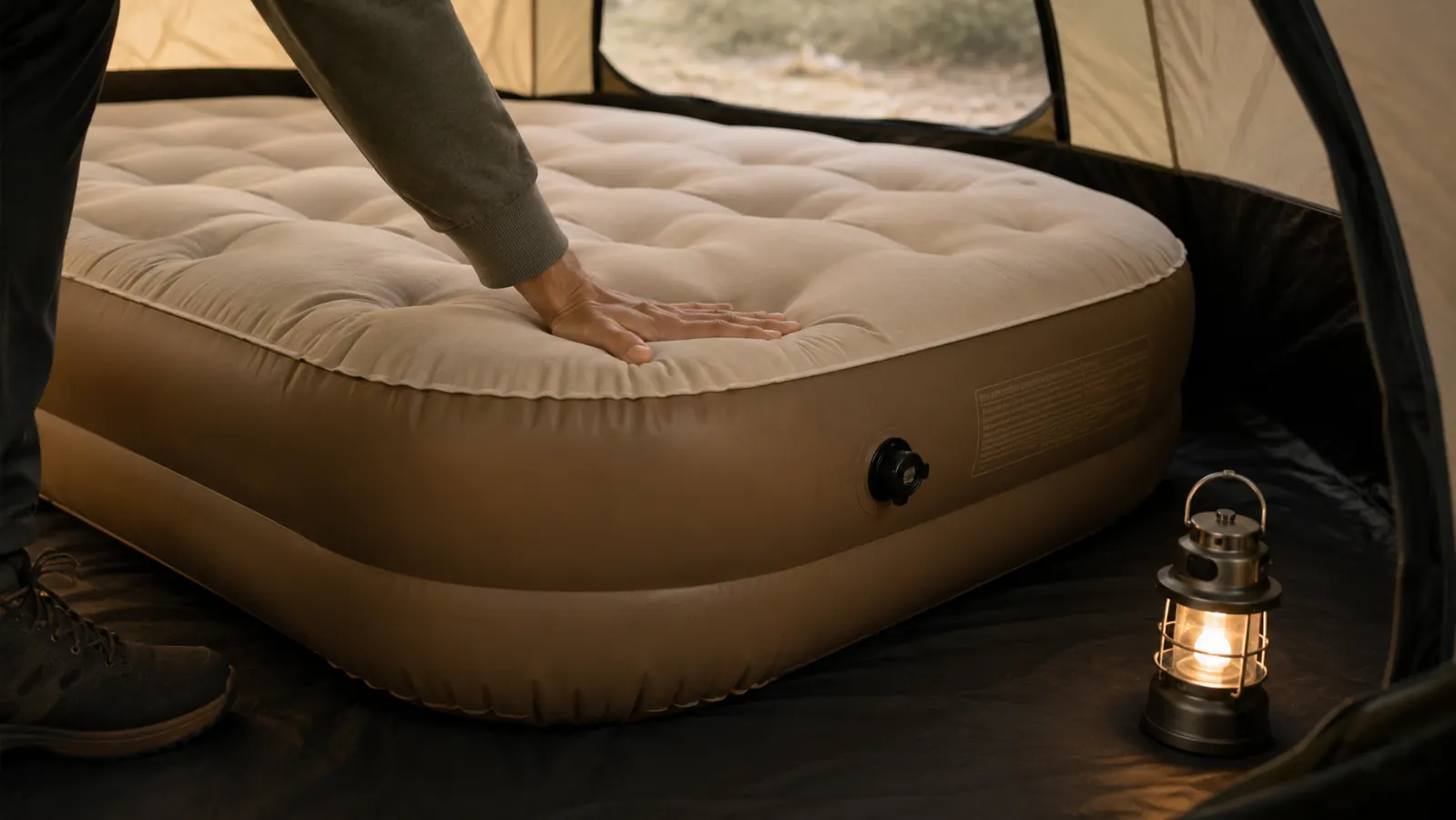
Start with the height. The Intex puts you 22 inches off the ground, which reads like a spec sheet number until your knees and hips weigh in. I can sit on the edge, swing my legs out, and stand up the way I do out of the bed at home. On pad nights it was a roll and a push, and after a certain age the ground reaches up and grabs you by the hip on the way down. My wife Deb stopped complaining about her lower back entirely the first weekend we switched.
Then there is the width, plus the fact that you can tune the firmness. A queen bed gives two grown adults room to sprawl, and I did not realize how much I missed that until I spent a night on a three-inch pad that slid whenever I moved. The built-in pump has a firm button and a soft button, so you set your own feel before you zip the tent. Deb sleeps soft, I sleep firm, we split the difference and both wake up better than either of us did on foam. And at today's price, the full queen undercuts most three-inch pads that carry a brand name.
For the record, I did not land on this mattress by luck. I compared it against the older air bed in my garage that needs a separate pump and a roll of tape, and against a cheaper inflatable mattress from the big-box aisle. The Intex wins on the pump alone, because a built-in pump means fewer pieces to lose and no midnight hunt for an adapter that got left in the other car. It also holds air noticeably better than the budget beds I have borrowed from friends. We run the firm button for three minutes and are asleep before the air stops moving.
The Dura-Beam construction behind the name is why it sleeps steadier than the cheap inflatables. The beams are built into the walls and floor, so the top does not hammock in the middle the way my old air mattress sagged by 3 a.m. And because it is a real queen, it doubles as a guest bed at home between trips. Deb's sister slept on it for a long weekend in May and asked me where the hotel mattress came from. That remains the best review this thing has ever gotten.
The mattress has also become the default spare bed for football season. When my brother-in-law drives up for a home game, it inflates in the guest room on Friday, and after Saturday's tailgate it is where the teenager who had one soda too many gets parked. A three-inch pad will never do that. The Intex earns its corner of the trunk twelve months a year, not just when the campgrounds are open.
Where a Self-Inflating Pad Wins
Give the pad its due on the cold. That foam core is insulation, and the Intex has nothing under you but air. The first cold night of every season, I feel it. Our September trip hit 38 degrees by midnight, and the top side of the mattress was fine while the heat slid right off my back into the ground. The fix is easy: toss a moving blanket or a reflective layer between the mattress and the tent floor. But it is one more chore on a cold night, and the pad simply never needs it.
The pad wins the packing fight outright, too. A good one, say a Therm-a-Rest Trail Pro, rolls down to the size of a rolled sleeping bag and weighs almost nothing, and it needs no power at all: unroll, open the valve, and it breathes itself up while you peg the tent. The queen mattress folds into a heavy duffel that earned its own corner of the trunk, and the pump wants a wall outlet or a car adapter. One honest caveat: any air mattress can pick up a slow leak in its third or fourth season, and you will spend an hour hunting it with soapy water. Foam in a pad has nothing to leak.
And to be fair about the solo test: if I were still the guy who hikes a mile into a fire tower for opening day, I would not own this mattress at all. The pad is half the weight, a quarter of the trunk space, and it rides on a backpack frame instead of needing its own seatbelt. There is no air bed on earth I would hump up a mountain. The mattress is a reward for driving, and the pad is a tool for moving. Different jobs, different tools, and I keep both.
There are also nights the pad wins for reasons that have nothing to do with weight. On a one-night stop at a highway campground where you roll in after dark and out at first light, the pad is on the ground in two minutes flat. In a downpour, the mattress has to come out, unroll, pump up, then deflate and fold while you are getting soaked, and the pad just shrugs the whole thing off. It is not that the pad sleeps better. It is that the pad is less work, and on the wrong kind of trip, less work is worth more than comfort.
Sleep 22 inches off the cold ground this weekend
The Intex Comfort Plush is my pick for anyone who camps out of a car and is tired of waking up stiff. Check today's price, and the 4.3-star average across more than 27,000 reviews says I am not the only one who thinks so.
Amazon Check Today's Price on Amazon →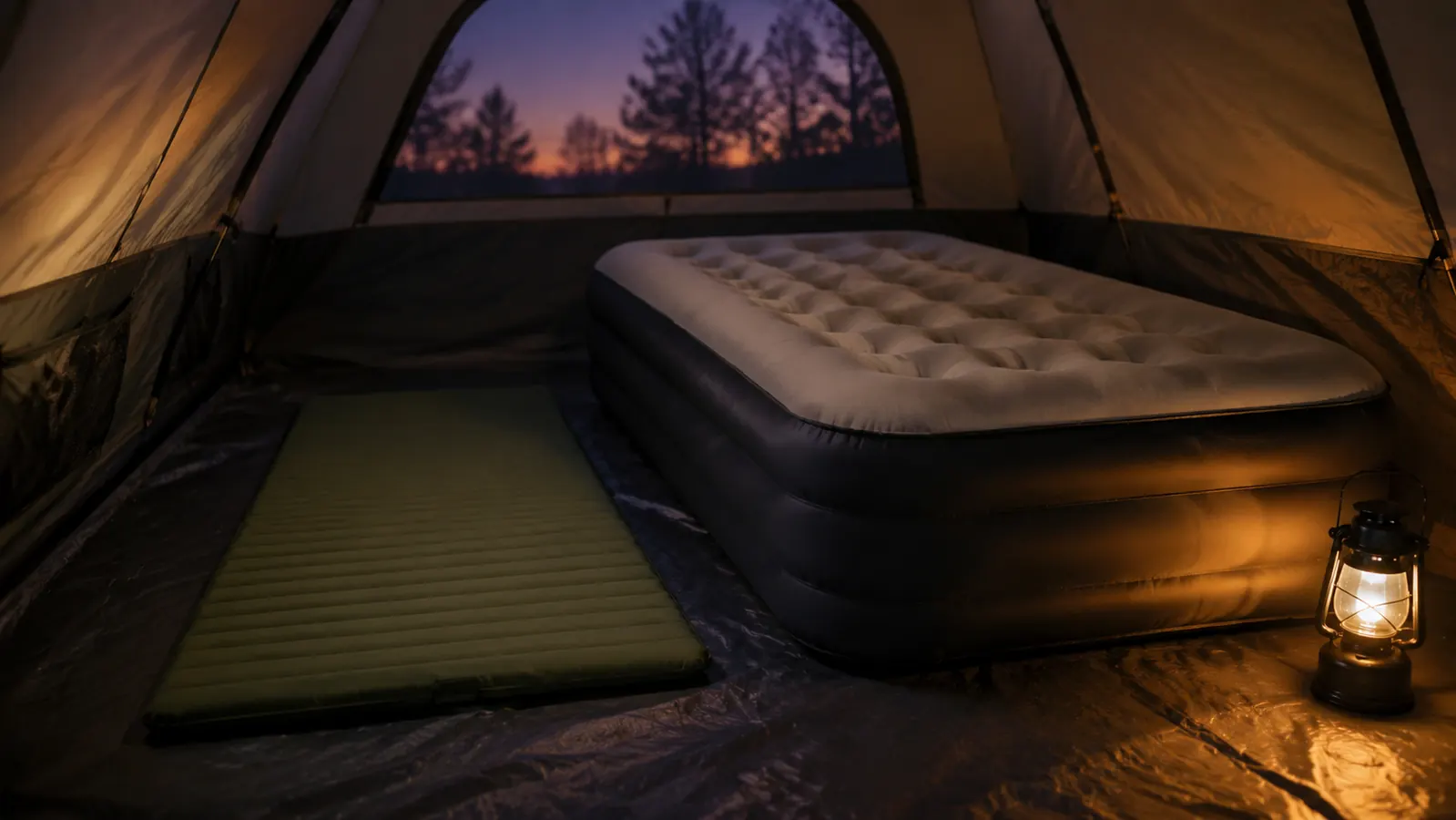
The Setup Reality
Here is what an Intex night actually looks like, so you know what you are signing up for. We pull into the site, Deb takes the tent, and I unroll the mattress flat inside, plug the pump into the extension cord I run from the car, and press the firm button. Three and a half minutes later it is a bed. The queen fits a six-person dome tent with room to spare, and it fits smaller tents through the door if you deflate it just enough to fold it through. It is a whole different routine from a pad, which you can toss through a window if you had to.
The 2 a.m. test is where the two split. Pads hum with every turn, the foam compresses under your hip, and you resettle three or four times a night. The Intex gives a little and then stays put, and because it is wider, a turn in the night is just a turn. Not perfect, mind you. It is still a blow-up bed, so it runs cool, it squeaks a little when two people turn at once, and on my first cold trip I had to top it off with a few minutes of pump time around 3 a.m. That is the honest list. I keep a notebook at the site.
One thing the specs will not tell you: the Intex is tall enough that it changes your tent routine. The bed fills the floor almost to the door of a four-person dome, and you learn to crawl in sideways over the foot of it. If your tent has a center pole or a ridge, check where it hangs, because the queen's 22 inches can press right up into the fabric on shorter tents. We run it in a six-person dome now and it sits fine, but a tall bed in a low tent is worth knowing about before you buy.
Run the pump before dark and you will thank yourself. The built-in blower is fast, but it is not quiet, and firing it up at 9 p.m. in a quiet campground earns you a look from the couple two sites over. I inflate right after setup, leave it topped off through dinner, and only touch the button again at bedtime if Deb wants it softer. Cold air cost me a little pressure overnight on our autumn trip, which is why the adapter now lives in the glovebox instead of the bottom of a gear tote.
Who Should Buy Which
If you drive to the site and the trunk is the ceiling on what you carry, buy the Intex. Double that if you share the bed. I walk through a full season of use in my long-term review, and the reasons a raised mattress beats a pad for car camping are all in my list of ten, so I will not repeat them here. Short version: this is the bed I pick every time the car is an option.
Get the pad if you backpack, bike camp, paddle a canoe, or spend your nights in a tent small enough that the word queen makes you laugh. Get the pad if you travel solo and could sleep on a sidewalk if you had to. It is the better tool for those jobs, full stop. And if you do the occasional two-nighter out of an SUV, you do not have to choose. I owned both for a season, until the mattress stopped going back in the house in May and never came out again until the last fall tailgate was finished.
One last note for the fence-sitters. If most of your trips are one-night stops at a highway campground on the way to somewhere, the inflate and deflate ritual starts to feel like a chore and the pad will look better every time. If your weekends run two nights or more, which is most of mine, the mattress earns back its fifteen minutes of pump time before breakfast on day one. Measure your trip before you measure your trunk.
My vote for car campers: the raised air mattress
Two summers of weekends, still inflates in about three minutes, still the best sleep I have had at a campsite. Check today's price on Amazon and read the rest of the reviews for yourself.
Amazon Check Today's Price on Amazon →