
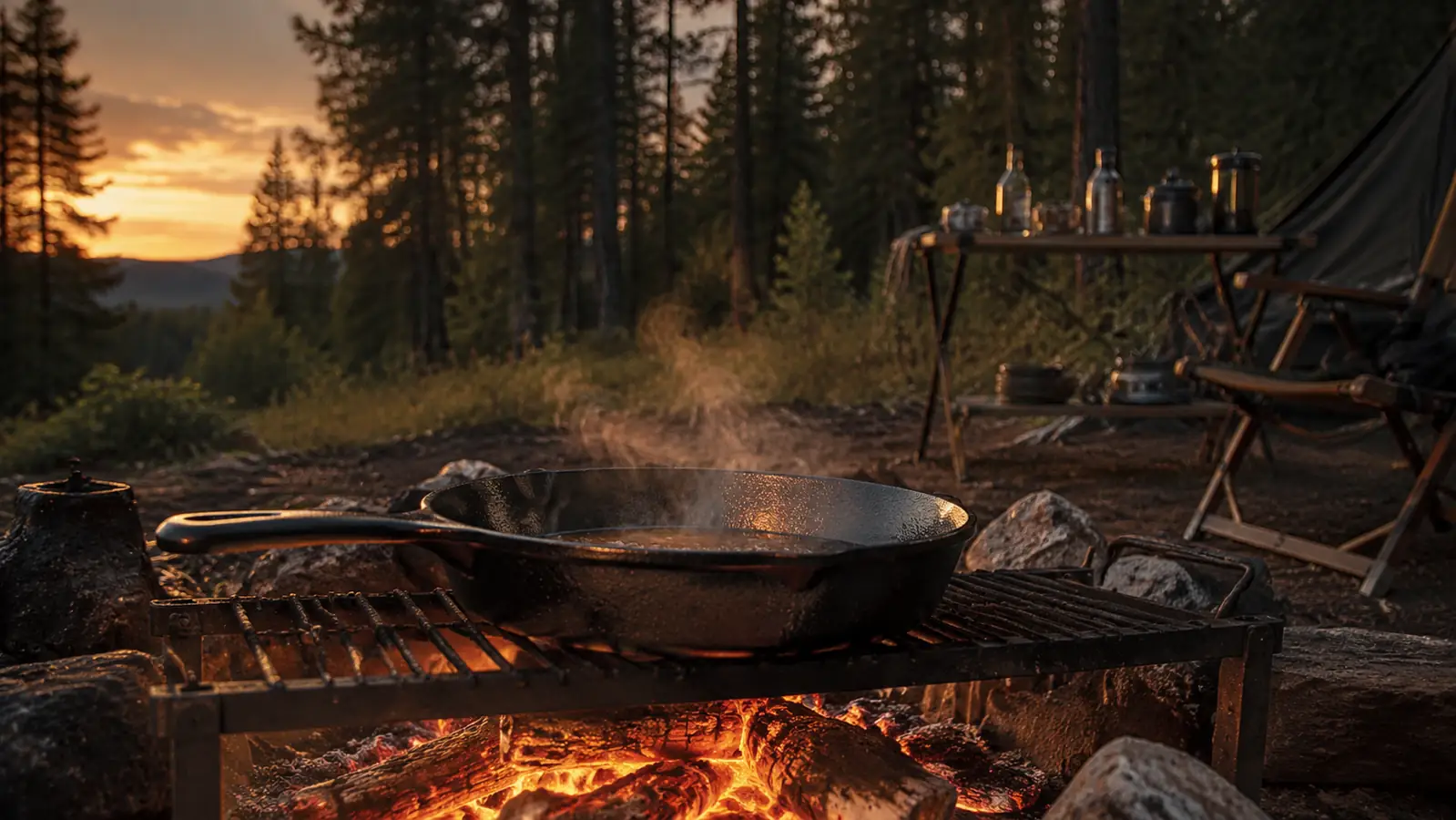
I'll be honest: I used to think camping food was just worse. Eggs stuck to the cheap folding pan, potatoes browned on one side and steamed on the other, and breakfast took forty minutes over a sputtering stove. Then I would come home and make the same eggs in eight minutes and wonder why I bothered leaving the house at all. Last spring, before a long weekend at Shenandoah, my wife Carol said we were bringing the good pan. She meant the cast iron skillet that has hung in my parents' kitchen for thirty years. Six months and five trips later, that Lodge 10.25-inch skillet has cooked every camp breakfast, every tailgate menu, and most Tuesday dinners, and it has a permanent spot in the camp box.
The pan is the Lodge Pre-Seasoned Cast Iron Skillet, the classic 10.25-inch that shows a 4.6-star average from roughly 132,000 reviews on Amazon. I usually ignore star counts. When that many people agree about a slab of iron, you listen. What a review page will not tell you is how a pan and its owner learn to cook together, and what this one does that the nonstick pan in your drawer flat out cannot.
The Quick Verdict
The Lodge 10.25-inch skillet is the one pan that cooks as well at the campsite as it does at home, once you give the seasoning a month and learn the dial. It replaced three pans in my gear and my kitchen, and I would not load the truck without it.
Amazon Check Today's Price →This Pan Ended Stuck Eggs at Our Campsite
If your camp breakfasts taste like a compromise and you are on your third flaking nonstick pan, this is the skillet that fixes the whole problem. Mine has done six months of trips and outlasted the pan it replaced, and today's price on Amazon is lighter than the pan itself.
Amazon Check Today's Price on Amazon →How I've Used It
Six months, five trips, and every home game in the stadium lot. The skillet came along to Shenandoah in April, a long weekend at Smith Mountain Lake in June, two nights at Grayson Highlands in August, and three nights along the Blue Ridge in September. It also rides in the truck for tailgates, which for our crew means burgers, peppers and onions, and a pan of cornbread if the weather holds.
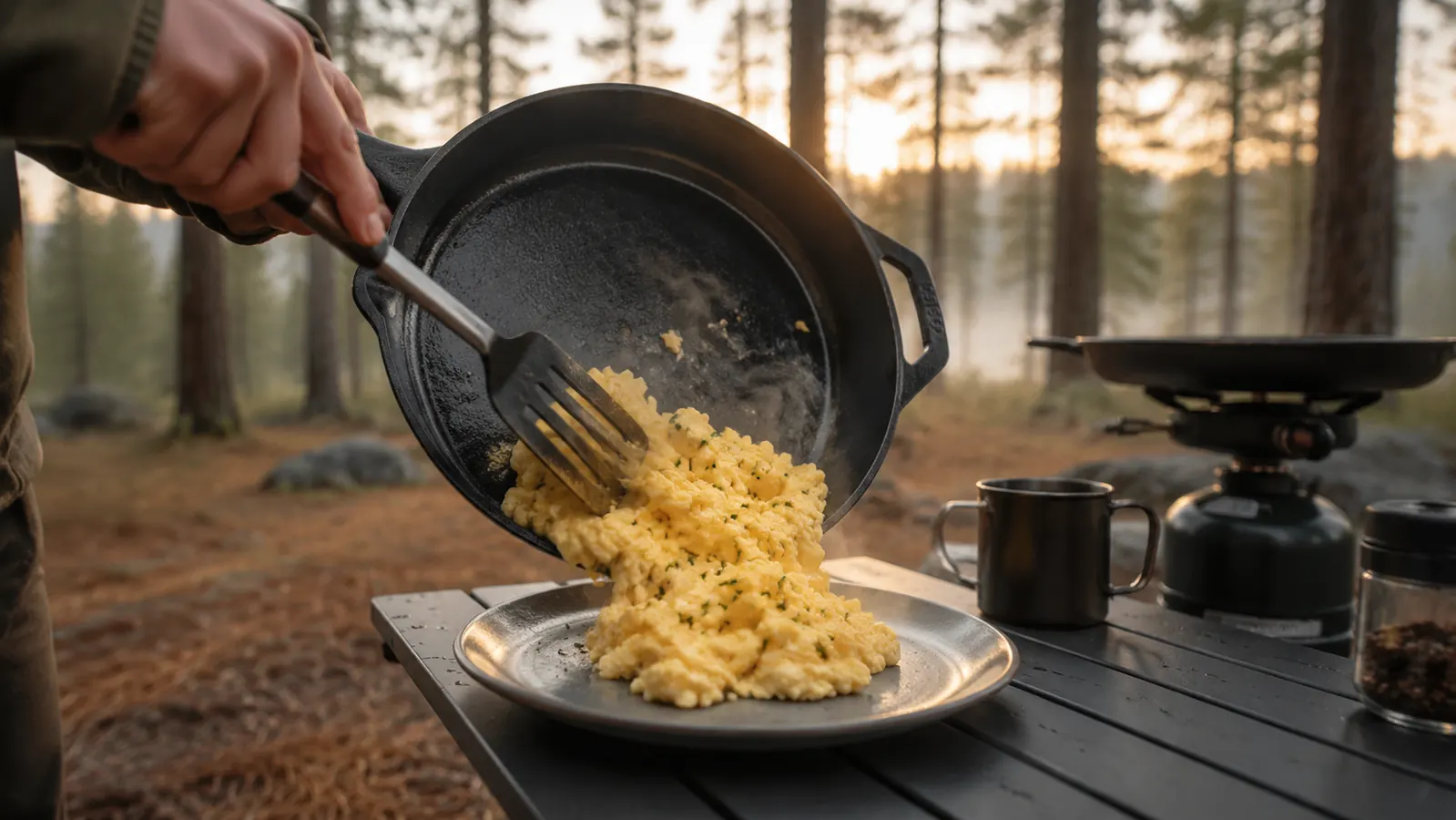
The first morning out I made the classic mistake: full heat and impatient eggs. The pan was not ready, the eggs were, and I spent ten minutes coaxing breakfast off the iron with a plastic spatula. By the August trip the same eggs released with a shake of the wrist. The pan learned me and I learned it. That is the whole story of this skillet in one paragraph.
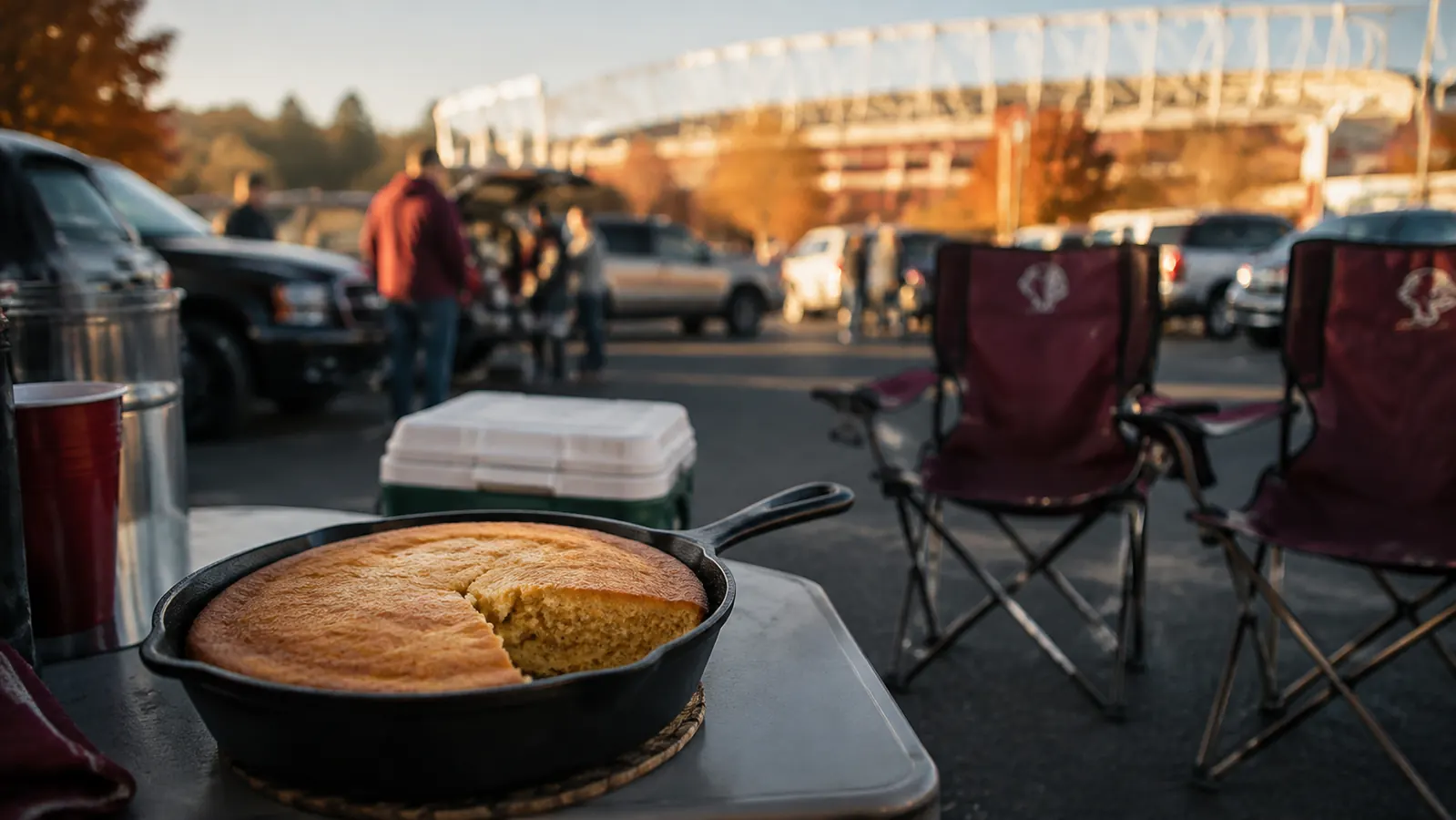
Breakfast is the honest measure of any camp pan, but the tailgate is where the Lodge earns its keep. On a Saturday in October we set up in the south lot three hours before kickoff, and the skillet never went back in the truck. It held peppers and onions over one burner while the charcoal chimneyed, then took the burgers straight off the grill's flame, then sat on the cooler lid keeping the cornbread warm while we ate standing up. Four adults, one pan, zero times someone said we should have brought another.
Between trips the same pan works the kitchen range, which is half the reason it earned a permanent spot. On a cold Tuesday in November I made the camp hash at home, sausage, potatoes, onion, and a fried egg on top, and it came out like it does at Grayson Highlands. That is the quiet promise of this skillet: the campsite and the kitchen are the same kitchen. Carol does not fight me for it, because she is usually the one who pulls it out first.
What 'Pre-Seasoned' Actually Means
Lodge bakes a layer of soybean oil into the iron at the factory. That is the seasoning, and it is a starting layer, not a finish. The photos on the product page make it look smooth and flawless; in person it is slightly pebbly under your fingers, which is normal. The surface improves with every fatty meal you cook, because each one adds a thin new layer of polymerized oil.
For the first month I kept it simple: bacon, burgers, cornbread, fried potatoes. I skipped tomato-heavy sauces and anything acidic, because acid eats seasoning. After every wash I dried the pan over the burner and rubbed in a thin coat of oil. That routine sounds like fussing, but it takes ninety seconds, and it is the difference between a pan that improves and a pan that rusts.
Two details from the box worth mentioning. The cast handle is one solid piece of iron with no rivets, which is exactly where cheap pans fail, and this one has not loosened a millimeter. And there is a grease well on the side for pouring oil off; I use it every time I cook bacon, and it saves me tilting a five-pound pan over the edge of the stove.
The Learning Curve Is Real, and Shorter Than You Fear
Cast iron holds heat instead of reacting to it. That is the whole trick and the whole danger. On a camp stove I run medium, not high, and I give the pan a full five minutes to preheat before anything touches it. When the handle end is warm to the touch, the cooking surface is close, and the coil dial matters less than you think.
The payoff is the sear. A burger hits the skillet and sizzles loud enough that the tailgate lot turns its head. A steak that would steam gray in a nonstick pan gets a real crust over a campfire grate. Once you accept that medium is plenty, the burning stops. My count was two ruined batches of eggs and one batch of potatoes before the iron and I came to terms.
Cold weather changes the math. At Shenandoah in April the mornings were in the low forties, and the camp stove out in the open ran like it was tired. I learned to preheat the Lodge a full five minutes with the lid on, because the lid keeps the heat inside the iron instead of letting the wind steal it. On the campfire grate the rule flips: coals, not open flame, and the pan sits close enough to sizzle but not so close that the handle, which I always grab with a mitt, turns into a trap. None of this is hard. It is just the difference between cooking with the pan and cooking against it.
Cleanup: The Tradeoff Nobody Puts on the Box
Here is the honest part. Cast iron is not dishwasher safe, it will rust if you leave it wet, and it asks for a little oil after washing. None of that is hard. In my kitchen it is a two-minute job: hot water, a stiff brush, dry over the flame, thin coat of oil, done. At camp I wipe it with a paper towel while it is still warm, which handles most of what sticks.
The tradeoff buys you a cooking surface that never wears out. My parents' thirty-year-old skillet proves the point. The nonstick pan this one replaced would have been restocked three or four times by now, and the Lodge is just entering its good years. That is not marketing talk. A coating is a consumable. Iron is not.
And for anyone worried that a camp meal means scrubbing at the spigot with sand, that has not been my experience. A fried-egg skillet cleans with one damp paper towel. A burger skillet needs a rinse, a wipe, and a fresh coat of oil the size of a dime before it goes back in the bag. On the two nights we cooked tomato-heavy chili it stripped a little seasoning from the cooking surface, the pan looked fine for a day, and a fatty breakfast the next morning put it right back.
What It Does That Nonstick Can't
Three things. First, direct flame: the Lodge sits right on a camp grate over coals, and nothing burns off because there is no coating to burn. Second, metal utensils: I use a spatula that would shred a nonstick pan and the iron takes it as a compliment. Third, it is PFAS-free by construction, which matters more to me the older I get.
It also moves between heat sources without a whimper. On a tailgate Saturday it went from the camp stove to the charcoal grill to the cooler lid, cooking peppers, then burgers, then cornbread, and never once complained about the temperature swing. The same pan makes a kitchen hash that tastes like camp for the days between trips, which is how it earned the Tuesday-night slot.
One more thing I did not expect: the pan handles crowds better than it has any right to. A 10.25-inch skillet is not a griddle, and I am not going to pretend it feeds a tailgate of eight from a single side. But it cooks in rounds, it holds heat between rounds, and it is back up to temperature by the time the last burger is off the flame. My old pan needed that whole stretch to catch its breath after every batch.
A note on size, because the reviews treat 10.25 as the automatic choice. For a couple or a family of four it is the right call. If you regularly cook for a full stadium lot, the larger Lodge sizes exist for a reason, and shift cooking in a 12-inch goes faster than shift cooking in this one. I mention it because a long-term review should tell you the honest edge of the thing, and feeding eight in one pass is that edge.
Three trips in, eggs released with a shake of the wrist, and the folding pan that came with our tent kit has sat in the garage ever since.
What I Liked
- Builds a genuinely slippery surface with use; eggs released cleanly by the third trip
- Takes direct campfire and grill heat with no coating to worry about
- PFAS-free and happy with metal utensils for the rest of its life
- One pan covers eggs, sear, cornbread, and tailgate burgers
- Durable enough to hand down; my parents' Lodge has thirty years on it
Where It Falls Short
- Heavy, around five pounds, and needs two hands when it is hot
- Rusts if you leave it wet, so it demands a short daily routine
- The factory seasoning is a starting layer, not a finish
- Holds heat so well it will burn food while you learn the dial
- The rough bottom can scratch a glass-top stove without a trivet
The Verdict After Six Months
Six months is where I stop calling something new and start calling it gear. By that measure the Lodge has earned its spot in the camp box. It has cooked over an open flame, on a propane stove, and on my kitchen range, in fog and in sun, and it has never warped, cracked, or lost the surface I built into it. The mornings I woke up stiff these past two seasons had nothing to do with breakfast, and that is because breakfast stopped fighting back.
I have bought a second Lodge since, as a gift for my nephew who just moved into his first apartment. He cooks over a kitchen stove, has no camping gear at all, and it is the same pan, which is the quiet point of this whole review: one skillet that does not care where the heat comes from.
For the record keepers, six months worked out to roughly two dozen camping nights, eleven home and away tailgates, and more Tuesday dinners than I can count. The skillet has seen rain, fog, a surprise frost, and one very crowded holiday kitchen. The surface looks better today than it did in May, which is the only maintenance report that matters.
If I had to hand someone a three-word summary of six months with this pan, it would be: buy the iron. Not because it is perfect, it is not, and I have listed every honest reason why. Because it is the one cooking purchase in my gear box that has never needed replacing, upgrading, or an apology, and that is a shorter list than you would think.
Who This Is For
Buy the Lodge if you are a car camper who cooks real meals instead of granola bars. The weight rides in the camp box, not on your back, and you get back a breakfast that tastes like your kitchen instead of like a compromise. It is for the tailgater who wants one pan that does burgers, peppers, and cornbread, and for anyone tired of buying a new nonstick pan every season.
It is also for the cook who wants one piece of gear that will still be going when the tent is retired. If you already own a cast iron skillet and love it, you know this pitch by heart. If you are still on the fence, the ten reasons a cast iron skillet belongs in every camp box cover exactly why mine never leaves the truck, and the camp kitchen guide walks through the meals that make it earn its spot.
Who Should Skip It
Backpackers and bikepackers, skip it. Five pounds of iron is a real toll on the trail, and a titanium pot will do more for less weight. Anyone with wrist or grip trouble should think twice about a hot, heavy pan that needs two hands to move. And if you will not spend ninety seconds wiping it down after dinner, every problem I listed above will find you.
One honest note for the stove shop crowd: on a glass-top electric range, set it on a towel or a trivet so the rough bottom does not scratch. And if you already own a Lodge or another good skillet, you do not need a second one. I almost bought a lighter carbon steel pan instead, and it would have cooked dinner fine, but it could not do any of this over an open fire.
One Pan That Fixes the Biggest Compromise in Camp Cooking
I went six months without reaching for a second pan, and I would not start a trip without this skillet in the box. If your cookouts end in stuck eggs and burned edges, this is the fix. Check today's price on Amazon.
Amazon Check Today's Price on Amazon →