

My Lodge skillet almost didn't make it out of the box. The day it arrived, the factory seasoning looked thin and patchy, the color of weak tea, and I was ninety percent sure I'd bought myself a future serving of rust. I left it on the counter for two weeks before I even bothered to wash it. A buddy of mine, a guy who cooks over a fire pit more than he does indoors, finally told me to stop babying it and just cook with it. So I did. A year later, with eggs, bacon, burgers, cornbread, and about eleven campsite breakfasts behind it, here is the honest review I wish someone had given me before I handed over my card.
The short version is this: it's the best pan I own, and I spent the first month absolutely convinced it was the worst. The long version is about seasoning, which is a word the box throws around like it means 'ready to use.' It doesn't. It means 'has potential.' Everything below is what learning that cost me, and what it will cost you, so you can go in with both eyes open instead of cursing at a stuck egg on a Saturday morning like I did.
The Quick Verdict
A rough first month, then the most reliable pan I own. Buy it ready to earn the seasoning and you'll get a skillet that outlives every other pan you've got.
Amazon Check Today's Price →The verdict in one line: one ugly month, then a decade of good breakfasts.
The Lodge 10.25-inch is where most camp cooks start and where most of them stay. The full honest story is below, including the month I wanted to throw it in the bushes.
Amazon Check Today's Price on Amazon →How I've Used It
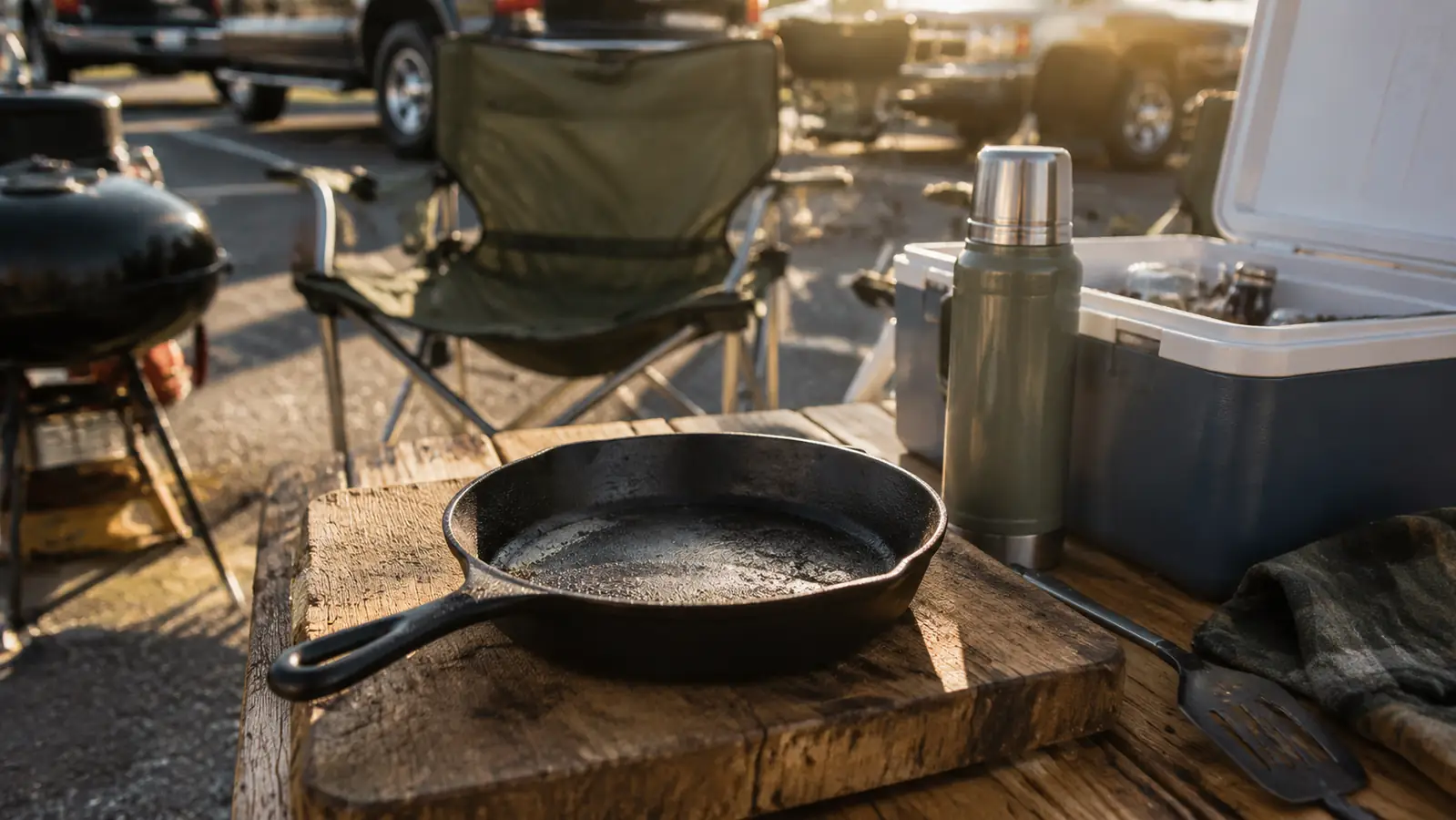
I'm a car camper and a tailgater, not a backpacker, so my skillet gets three kinds of work. Weekend trips to a state park about an hour from the house. A parking-lot cookout before every home game, where the pan comes out of the tote and bacon hits the grate by seven. And most weeknights at home, because once the seasoning came together, this became the pan I reach for without thinking.
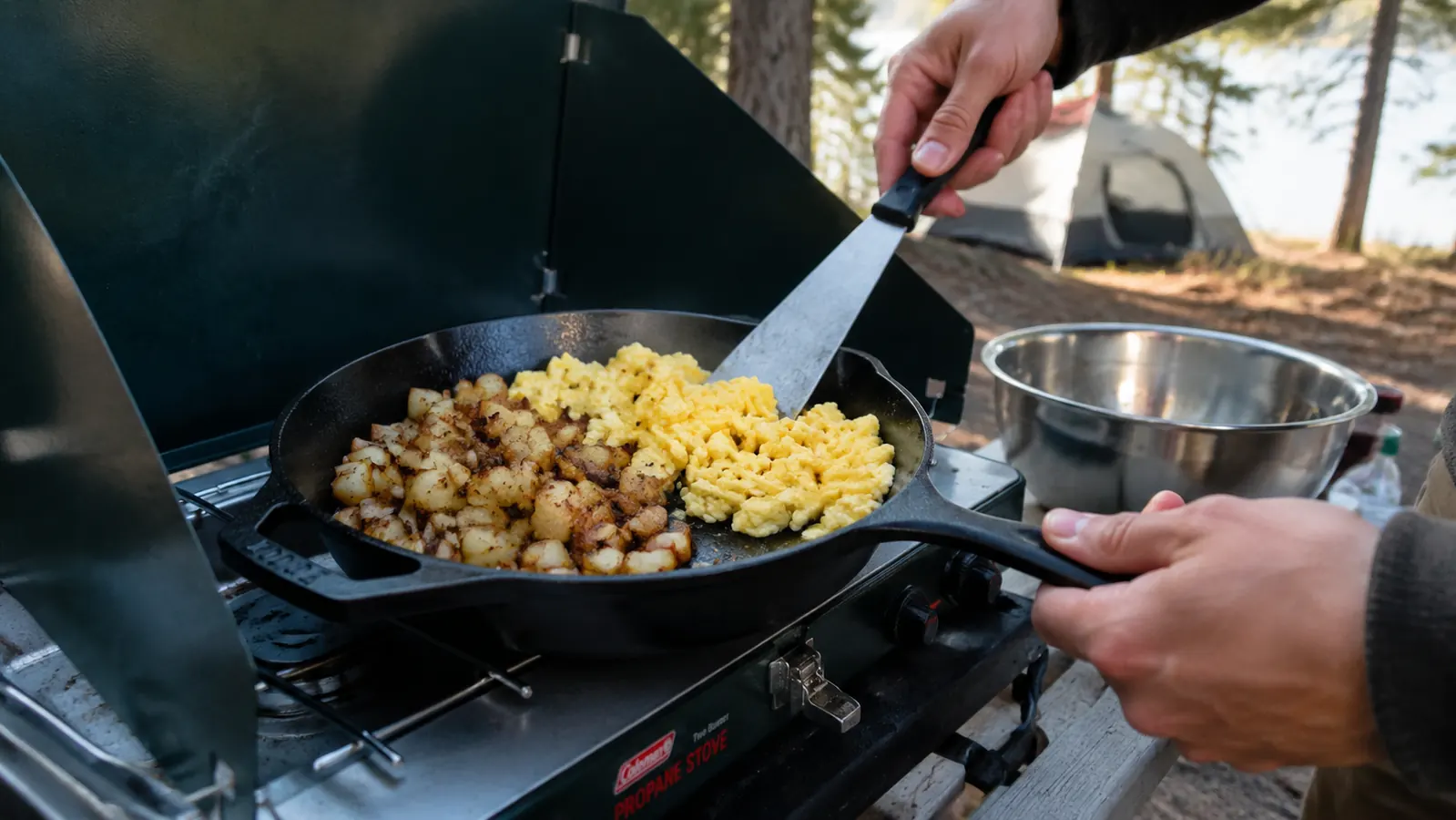
The exact pan is the Lodge 10.25-inch pre-seasoned skillet, the plain one with the helper handle on the far side. It weighs about five and a half pounds, which keeps it out of any backpack but makes it the right size for two people and a hungry neighbor from the next site over. I've cooked on a two-burner propane camp stove, on a grate over a fire ring, and on a gas range at home, and it behaves differently on each one. That range of behavior is half the reason I like it.
The timeline is what I want you to take away from all of this. Month one was frustration, pure and simple. Months three and four were a slow, unglamorous build. By month six the cooking surface had gone from patchy to glassy, and by month nine I could cook a dozen eggs that slid off without a single scrape. That progression, not the pan out of the box, is what you're actually paying for, and nobody told me that.
The Truth About the Factory Seasoning
Lodge ships this pan with a base layer of seasoning already baked on, and 'pre-seasoned' sounds like 'ready to go.' It's not. That first layer is meant to protect the iron from rust in the warehouse, not to give you a nonstick surface. Thin is the right word for it. A pot of tomato sauce will eat through it. A wet pan left overnight will spot it. None of that means the pan is defective, and I wasted a good month and a half thinking it was.
What that factory layer actually does is hand you a head start toward a real seasoning, which is just layer after layer of oil heated until it polymerizes into a hard, dark coating. Every time you cook with oil and heat, you add a little. Every time you cook acidic food or scrub hard, you subtract a little. The pan in my kitchen today is the same iron that came out of the box. It's just wearing a coat I spent a year building, one meal at a time.
Here's the honest cheat code I wish I'd had on day one. If you want to compress a month of seasoning into a weekend, cook bacon first. Three or four pounds of the fatty stuff, fried low and slow, with the grease poured off and the pan left to cool on the stove. My neighbor Dale did exactly that with his pan and skipped the patchy phase entirely. I ate the patchy phase, and I'm still a little salty about it.
One more thing about that seasoning, and it is the part the box does not warn you about. Most pans pass through an ugly middle stage where the surface turns gray and tacky, usually because someone used too much oil and let the pan cool instead of baking it in. A tacky skillet is not a ruined skillet; it needs a burner on medium until the surface dries out and smooths over. Mine went from a patchy tan through a splotchy gray stretch in month two and settled into a deep, even brown that looks like it belongs to the family. If yours looks like a salvage project right now, it is working as intended.
The Sticking Phase (and When It Ends)
Nobody warns you that a brand-new cast iron pan sticks worse than a nonstick pan at the end of its life. My first attempt at eggs spread across the surface like glue, and I stood there scraping Sunday breakfast into a sludge with the corner of a metal spatula. It felt like proof that I'd wasted my money. It was not. It was the pan's way of telling me we weren't done with the basics.
Heat is the missing variable, and it's the answer to ninety percent of the 'cast iron sticks' complaints you'll read online. A new pan holds heat unevenly, and the cold spots are what grab food. I stopped cranking the burner to high and started preheating low and slow, a good three or four minutes before anything touched the surface. That one change did more for me than a year of scrubbing ever could have.
While you wait for the turn, cook the foods that flatter a young pan and skip the ones that fight it. Bacon, burgers, cornbread, fried potatoes, and hash all build seasoning while they cook. Delicate fish and tomato-heavy sauces will frustrate you for those first weeks, and I stopped bothering with both until the surface had some miles on it. For the first two months my Sunday routine was a pan of potatoes every morning, because every batch left the iron a little better than it found it. Small repeatable wins are how you get from stuck to sliding.
The day it turns, you'll know. Mine flipped around month four, when the eggs started sliding on their own. Dale's flipped at month three because he baked a coat on in the oven after every use. Both timelines are entirely normal, and both start with food that glues itself to the pan. If this is where you are, your pan is not broken. You're just inside the learning curve, and the exit is real.
The pan that stuck on day one slid eggs on its own by month four, and it outlived three nonstick skillets in its first year.
Rust Isn't a Death Sentence, but It Will Find You
My first rust spot showed up in October, after a wet camping trip where I dried the pan with a paper towel, nodded, and slid it into a plastic tote for the drive home. Two days later the cooking surface had orange freckles. My first instinct was panic, because every cast iron article on the internet makes rust sound like the end of the world. My second instinct was the right one: rust on cast iron is cosmetic, it's fixable, and the pan was nowhere near ruined.
The fix took ten minutes. Warm water, a stiff brush, a thin coat of oil, and a few minutes back on a low burner. The freckles vanished and the pan carried on like nothing had happened. What I learned is that the pan's real enemy is water left to sit, not water itself. Modern dish soap is fine, the old wives' tale about it stripping seasoning died with the old soap. But a damp pan drying on the rack is how you invite the rust back.
So here's the whole maintenance routine, which is shorter than people make it sound. Wash it after dinner. Dry it on the burner until it stops steaming. Wipe in about a teaspoon of oil while it's warm. Put it away. That's ninety seconds, and it's the entire cost of ownership. It's also why this pan has outlived the three nonstick pans I bought in the same twelve months because I kept telling myself the next one would last.
The part that only shows up after you have owned the pan for a while is storage. I keep the skillet in a canvas tote with a folded towel between it and the Dutch oven, because iron resting against iron will rub seasoning clean off a corner. My earlier method, stacking it loose next to the camp stove, produced a fresh crop of edge chips on every single trip. Now the pan dries on the burner, gets its coat of oil, and goes to sleep wrapped in that towel. That wraps up the whole routine, and I have not seen a rust spot since October.
What This Pan Does at the Campsite That Nothing Else Can Match
A camp stove gives you a burner, but it gives you no oven, and that's where the skillet becomes the workaround. I make cornbread on Sunday-to-Monday trips: batter mixed in a stainless bowl, poured into the warm greased iron, lid on, embers from the fire ring shoveled on top. It bakes. Not quite like the one at home, close enough that Margaret asked me to write down how I did it. The same trick covers a campfire cobbler, a skillet pizza, or a stew you'd normally need a pot for.
It also holds heat in a way no thin pan can, and that's the whole tailgate argument. Burgers get a real sear instead of a gray steam, which is the difference between a parking-lot burger that tastes like a concession stand and one that tastes like the grill at a friend's house. I pour the bacon grease into a mason jar after every trip, and that jar has become the most fought-over ingredient in the camp kitchen.
Over a live fire, the weight is the point, not the drawback. A thin pan warps and scorches when the fire throws a hot pocket at it. The Lodge just takes the heat and hands it to the food slowly, which is exactly what you want when you're cooking over flames that refuse to behave. Mine has been through a full season of fire rings and sputtering camp stoves, and it still sits as flat today as the day I unpacked it.
The memory that sold me for good was a cold October night when a father from the next site over walked up holding a stringer of fresh trout, a plate of lemon slices, and no plan at all. I had a skillet, a stick of butter, and embers that had finally settled. Ten minutes later six people were eating fish that came off a fire grate tasting like a restaurant plate, and he kept asking what was in the pan. The answer was nothing special. The skillet had sat in the corner of my camp box all afternoon, waiting for exactly that moment.
The Tradeoffs Nobody Puts on the Box
Now the other side, because a review that skips this is the reason you're reading one that doesn't. The pan is heavy, about five and a half pounds, and the long handle gets hot enough to leave a mark if you grab it bare. You need a mitt or a folded towel every single time. I own the scars from the one time I forgot, and I'd rather you learn the same lesson at no charge.
It won't go in the dishwasher. It's not great with tomatoes or vinegar braises until the seasoning is well established, because acid eats fresh seasoning fast. If you leave acidic food sitting in it overnight, the pan and the food will both let you know in the morning. And it needs to be stored with the surface protected from water and from other pans banging into it. If that reads as a lot of rules, you're right, and you're reading the honest version of this review.
For me, the ledger already balances. The pan lives on the stovetop full time now, two steps away for eggs, cornbread, and the smash burgers that quietly became our Friday routine. The maintenance is a habit, no different from brushing the grates on a grill, and anyone who has owned a grill for longer than a season already understands the deal.
And I'm not going to pretend every meal came out perfect. The worst miss was a damp fall Friday when I rushed a batch of cornbread: cold batter into a warm pan, on a burner I hadn't given time to settle. It stuck hard and came out in pieces, and I spent the walk back to the truck explaining to the kids that dinner was now skillet hash, which is the polite name for the same mess fried twice. The lesson was mine, not the pan's, and you can make that exact mistake with any pan you own. But with cast iron the surface is still there tomorrow, and I'd rather have the pan that forgives a little acid, a little haste, and a whole lot of fire.
What I Liked
- Holds heat like nothing else, from a camp stove to an open fire
- After the first ugly months it turns into a real nonstick surface that never needs replacing
- Almost zero ongoing cost, just the oil and heat you already have
- Rust and seasoning mistakes are fixable in ten minutes, not the end of the world
- The 10.25-inch size feeds two people and a hungry neighbor
Where It Falls Short
- Heavy, about five and a half pounds, and the bare handle is a burn hazard
- The first month is genuinely frustrating as eggs stick and the finish looks patchy
- Won't go in the dishwasher and needs a wash, dry, and oil after every use
- Acidic foods like tomatoes strip new seasoning if you lean on them early
Who This Is For
If you camp out of a car or a truck, cook at a tailgate, and want campground food that tastes like home food, this pan is for you. The weight is a nonissue when it rides in a tote instead of a pack. The heat control forgives a camp stove that misbehaves. And the price lands low enough that a bad first month reads as a learning curve, not a loss. It's also for anyone tired of replacing nonstick pans every couple of years when the coating finally gives out.
Who Should Skip It
If you want a pan that works perfectly on day one with zero maintenance, skip it and buy a good nonstick. If you're a backpacker counting every ounce, five and a half pounds will ruin your pack before it ruins your eggs. And if you can't stand the idea of drying a pan on the stove and wiping in oil after every meal, you'll grow to resent this one inside of a month. That's not a knock on the pan. It's the honest warning I wish someone had given me.
The pan that starts rough and finishes strongest.
After a year of heavy use, my Lodge 10.25-inch skillet is the first pan out of the camp box and the last thing I'd replace. Check today's price and see why so many camp cooks still reach for plain cast iron.
Amazon Check Today's Price on Amazon →